


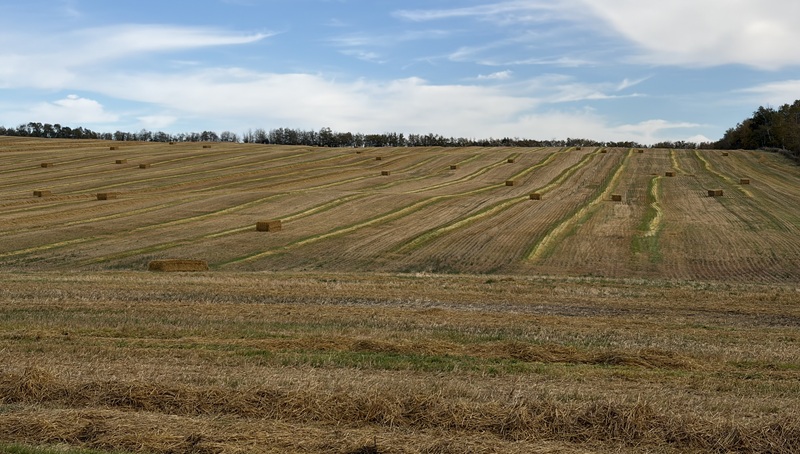
As of Oct. 6, combining of major crops in the North West Region progressed 28 per cent over the last week and is now 74 per cent complete.
That’s according to the latest crop report by the Agriculture Financial Services Corporation (AFSC) and the Government of Alberta.
This is behind the five-year average of 88 per cent and ahead of the 10-year average of 66 per cent. Frost has been frequent, along with cool and damp weather making crops tough and requiring additional on-farm drying.
While 59 per cent of canola is combined, another 22 per cent is in the swath.
The report says canola is expected to grade 69 per cent 1 Can. and 17 per cent 2 Can. while dry peas are expected to have 30 per cent grade 1 Can. and 60 per cent grade 2 Can. It is expected that 43 per cent of hard red spring wheat, 15 per cent of eligible malt varieties and 41 per cent of oats will grade 1 C.W.
Pasture growth conditions (five-year average) are rated as zero (30) per cent poor, 18 (44) per cent fair, 70 (26) per cent good and 12 (zero) per cent excellent.
Overall, favourable weather advanced the provincial major crop harvest by 18 per cent to 78 per cent complete. This marked the third consecutive week of gains between 17 and 21 per cent. Progress remains behind the five-year average of 94 per cent (in three of the past five years, harvest was at least 96 per cent complete by this week) but is close to the 10-year average of 79 per cent.
The South Region leads major crop harvest progress at 89 per cent complete, below its 10-year average of 92 per cent. The Central Region at 86 per cent is the second most progressed, ahead of its 79 per cent 10-year average. The North West Region is 74 per cent complete, ahead of its 10-year average of 66 per cent, while the North East Region is at 71 per cent, below its average of 75 per cent. The Peace Region is the least progressed at 62 per cent complete, behind its 10-year average of 74 per cent. All regions remain between nine and 29 per cent behind their five-year averages.
According to the AFSC, by crop, harvest of dry peas is virtually complete, followed closely by cereals. Spring wheat is 89 per cent harvested and barley 91 per cent, while oats and canola trail at 74 and 56 per cent, respectively. A further 23 per cent of canola is swathed, with many reports of green counts and uneven maturity.
Ergot in spring wheat is an issue in some areas of the North East and North West, while high harvest-season moisture has also increased weed pressure across the province. Annual weed pressure is rated 17 per cent moderate and three per cent heavy, compared to the five-year averages of 11 and two per cent. Perennial weed pressure is rated 15 per cent moderate and three per cent heavy, compared to the five-year average of nine and one per cent, according to the report.
Fall seeded crops are rated 70 per cent good-to-excellent provincially, compared to the five- and 10-year average of 46 and 59 per cent. The highest rating of fall seeded crops is in the North West at 97 per cent good-to-excellent, followed by the South at 84 per cent and the Peace at 67 per cent. Both the Central and North East are rated 47 per cent good-to-excellent.
The AFSC reports that the five-year dryland provincial yield index currently estimates that major crops will yield 21 per cent above of the five-year average. Major crops are expected to yield above the five-year average, specifically in the South (59 per cent above), Central, (24 per cent above), North East (seven per cent above) and Peace (16 per cent above). The North West Region is expected to yield 10 per cent below its five-year average yield.
Provincially, spring wheat is currently expected to average 53.9 bushels/acre, barley is expected to yield 73.8 bushels/acre, oats are expected to yield 78.4 bushels/acre, canola is expected to yield 38.1 bushels/acre and dry peas are expected to yield 42.1 bushels/acre.
Quality ratings of crops already in the bin are currently above their five-year average for spring wheat (63 per cent 1 C.W.), durum (59.9 per cent 1 C.W.), canola (89 per cent 1 Can.), and dry peas (27 per cent 1 Can.), malting varieties of barley (31 per cent 1 C.W.) and other barley varieties (59 per cent 1 C.W.). Quality ratings of oats are currently below their five-year average and 22 per cent are rating 1 C.W.
Moisture conditions remained quite stable across the province over the last week as less than five millimetres was reported for most of the province, the report notes. Conditions remain significantly above their five-year averages for both surface and sub-surface.
Surface soil moisture increased one per cent and is rated 70 per cent good-to-excellent, above the five- and 10-year averages of 33 and 51 per cent. The highest surface soil moisture ratings (five-year average) were reported in the Peace Region at 91 (53) per cent while the lowest was in the Central Region at 52 (35) per cent. The North East, North West and South regions are rated (five-year average) at 71 (29), 73 (43) and 76 (22) per cent good-to-excellent, respectively.
The AFSC says provincial sub-surface soil moisture decreased by half a per cent and is now rated 64 per cent good-to-excellent, but remained well above the five- and 10-year average of 27 and 45 per cent good-to-excellent. The highest surface soil moisture rating (five-year average) was in the Peace at 97 (52) per cent good-to-excellent, while the lowest was in the Central Region at 54 (24) per cent good-to-excellent. The South, North West and North East are at 55 (17), 69 (45), and 74 (27) per cent good-to-excellent.
Warm weather and adequate soil moisture have helped pasture conditions remain above average for this time of year and support fall grazing. The report says pasture growth conditions are rated 50 per cent good-to-excellent compared to the five- and 10-year average of 23 and 34 per cent good-to-excellent. While most regions remain significantly above their historical average, the Central Region is on par with its five-year average, rated 21 per cent good-to-excellent.
Pasture growth (five-year average) is reportedly rated 68 (27) per cent good-to-excellent in the South, 51 (12) per cent in the North East, 82 (26) per cent in the North West and 48 (32) per cent in the Peace. Some areas are still cutting and baling their second cut hay crops.
Provincially, for total dryland hay, 87 per cent was from the first cut and 13 per cent was from the second cut where first cut averaged 1.9 tons per acre and second cut averaged 1.5 tons per acre. This is above the five-year average for first cut (1.3 tons per acre) and second cut (1.0 ton per acre).
Provincially, forage reserves (feed grain reserves) are rated as three (three) per cent deficit, six (eight) per cent shortfall, 75 (77) per cent adequate and 17 (12) per cent surplus.
The North West Region includes Barrhead, Drayton Valley, Edmonton, Leduc and Athabasca.