


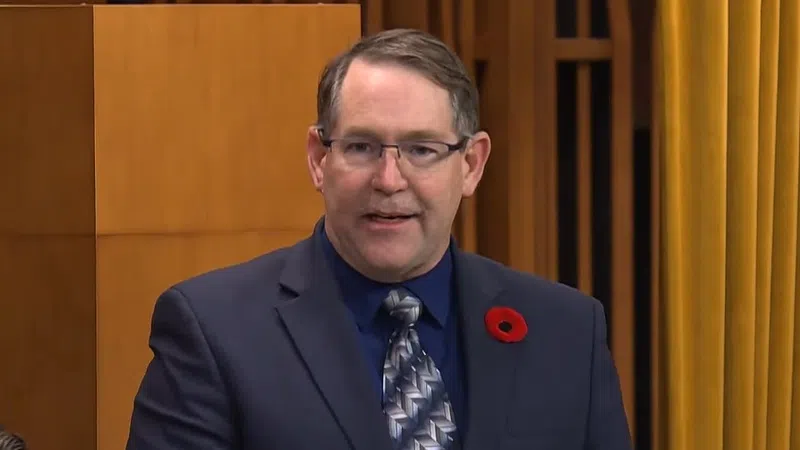
Yellowhead MP William Stevenson says the federal Liberal government’s proposed budget will only increase the burden on Canadian families, driving up costs of food, fuel and other essentials.
“Food Banks Canada has given this Liberal government an “F” when it comes to poverty and food security,” he said. “With Canadians paying over $800 for food this year than they did last, it’s no wonder food bank usage has skyrocketed around the country.”
Rising in the House of Commons on Nov. 5, Stevenson blamed what he called “hidden” industrial carbon taxes on fertilizer, fuel and farm equipment on an increased cost of living.
“This has become so unsustainable, that more families are going hungry every day.”
Other than some previously announced funding for Jasper recovery, Stevenson says he doesn’t see much in the budget that will benefit the Yellowhead riding.
“There’s $78 billion for a deficit that’s the largest outside of COVID, with interest on what they’re financing being $5400 per household,” he says. “It doesn’t help us in Yellowhead, that’s for sure.
Yellowhead MP William Stevenson shares initial thought on the Liberal’ 2025 budget
Prime Minister Mark Carney said this week the federal budget is a “bold response” to a global moment of economic disruption, replying to critics who question the ambition of Ottawa’s plans.
“These profound changes require a bold response, and that’s what we got yesterday,” Carney told a news conference in a public transit yard in Ottawa.
The budget predicts that, in terms of real GDP, Canada’s economy will be 1.8 per cent smaller by the end of 2027 than forecasts suggested late last year — before U.S. President Donald Trump launched his global tariff campaign.
Carney claimed measures in the budget will help Canada meet a lofty goal of attracting $1 trillion in investment over the next five years. That level of investment, if it comes to pass, would more than offset the disruption caused by U.S. tariffs.
“Now is not the time to be cautious, because fortune favours the bold. It is a time to get big things done for Canadians, and get them done fast,” he said.
Wednesday marked the start of Carney’s campaign to sell Canadians on the first government budget released under his watch.
He was joined at the event by Nova Scotia MP Chris d’Entremont, who left the Conservative caucus to join the Liberals on Tuesday, moving them within two votes of a majority.
In an interview with Pattison Media, Stevenson says he doesn’t anticipate any more floor crossings — but didn’t rule anything out.
“We had a caucus meeting on Wednesday, from my perspective we seem pretty united,” he says. “I think it’s a lot of speculation — you never know, I could be wrong — but I don’t think it’s going to happen myself.”
He adds, d’Entremont had “personal reasons” for quitting.
The Liberals will need to find votes — or abstentions — if they are to get the budget passed and survive a confidence vote which could trigger a federal election.
The budget includes nearly $90 billion in net new spending over five years, after government cost-savings goals are taken into account. The plan has received a lukewarm reception from opposition leaders.
Conservative Leader Pierre Poilievre lambasted the Liberals in question period Wednesday over high levels of spending and maintaining the industrial carbon price, which he argues places undue burden on manufacturers and raises costs for Canadians.
Poilievre said that the $78.3 billion deficit in the budget is the largest in Canadian history outside the pandemic.
Long-time Liberal adviser Tyler Meredith pointed out on social media that, according to the Bank of Canada’s inflation calculator, then-prime minister Stephen Harper’s 2009-10 budgetary deficit of $55.6 billion is larger than the 2025-26 deficit, in today’s dollars.
Poilievre signalled Tuesday that the Conservatives would introduce a budget amendment to cut bureaucracy and kill the industrial carbon price.
Typically the Official Opposition introduces the main amendment to a budget and the third party in the House of Commons introduces a subamendment.
But in the midst of debate over the budget in the House of Commons Wednesday Poilievre failed to table his amendment, opening the door for the Bloc Québécois to do so instead.
Its amendment calls on parliamentarians to reject the budget in its entirety, primarily for a lack of measures targeting Quebec.
The Conservative party confirmed to The Canadian Press it would table a subamendment to the Bloc’s amendment Thursday morning. The first budget vote will take place Thursday evening, on the Conservative subamendment, and the second vote will be on the Bloc amendment on Friday.
It’s not clear at this point if the government will deem the amendment votes to be confidence matters, but the main vote on the budget will be. It won’t take place until the week of Nov. 17, as the House is on a break for Remembrance Day next week.
Carney said there’s “a lot in this budget” that reflects input from other parties. He said there’s alignment across the government and opposition parties on aspects of the budget.
~ with files from the Canadian Press